Perilous Pathways: Mapping Pennsylvania’s Abandoned Wells
Click here to view a map of every known abandoned well in Pennsylvania. These 8,255 wells represent just four percent of the abandoned wells out there. Continue reading
Earlier this week, StateImpact Pennsylvania reported on the small - but growing - market for natural gas-fueled cars. Click here for a map of the stations where Pennsylvania drivers can fill up with compressed natural gas. Continue reading
Bill Peiffer checks out an abandoned oil well in the Tamarack Swamp in Warren County. Tom Savko sits in the distance.
This road leads to another old gas well that the EPA has permitted to be turned into a deep injection well. The permit was challenged by area residents.
An abandoned oil well dating back to the early 19th century spills oil into the Tamarack Swamp in Warren County.
When you drill for natural gas, for every gallon of gas produced, some amount of wastewater gets created as well.
Sometimes it can be simple brine that can be disposed of in simple ways, such as using it to melt snow on Pennsylvania’s roads in winter. Or to keep the dust down in summer.
But the wastewater can also be pretty nasty stuff, which can’t be cleaned up by water treatment plants. One option is to dump it down an old gas well, shooting it deep into the earth. It’s a method used in thousands of wells across the country. Only five of those currently operate in Pennsylvania.
A proposal to add to that number is stirring concern among some who live in Warren County, Pennsylvania, near the New York state border.
Fueling those concerns are the headlines such deep injection wells, or underground disposal wells, recently made when one such well in Youngstown, Ohio, caused several earthquakes. But residents are also worried about the impact on water supplies and natural areas. With the Marcellus Shale boom, the EPA has received several new applications for deep injection wells in Pennsylvania. Continue Reading
The location, status and monthly injection allowance of all eight deep-injection wells permitted to receive oil and gas drilling waste in Pennsylvania. Continue reading
Now that the Department of Environmental Protection has released an interactive list of wells this year's impact fee revenue will be based on, StateImpact Pennsylvania has updated its county-by-county map of fee revenue. The new list adds more wells, increasing the estimated statewide total to $211 million. Continue reading
Where does Pennsylvania’s used fracking fluid go? More and more of it is being shipped to Ohio, where it’s deposited in deep injection wells. View them here. Continue reading
Which Pennsylvania counties have enacted a natural gas drilling impact fee? Click on StateImpact Pennsylvania's new map to find out. Continue reading
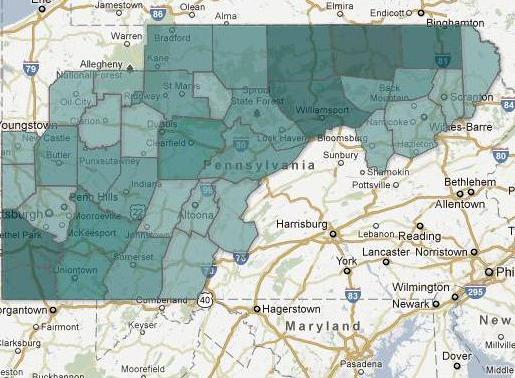
When the first round of natural gas impact fee payments is collected on September 1, how much money will each county receive? Click on our interactive map to find out.
Based on 2011 natural gas prices, drillers will pay $50,000 for every horizontal well “spudded” before 2012, and $10,000 for each vertical well.
According to StateImpact Pennsylvania’s projections, which are based off the Department of Environmental Protection’s latest “spud report,” the fee will generate more than $200 million, with nearly $50 million coming from Bradford County, alone.
This map tracks how much money county governments will receive from the first round of impact fee payments, which is due September 1, 2012. It applies the retroactive 2011 fee - $50,000 for horizontal wells and $10,000 for vertical operations - to every well from 2005 to 2011 listed in the Department of Environmental Protection's most recent "spud report." Continue reading
Who’s drilling where?
It’s the basic question everyone wants to know about Pennsylvania’s Marcellus Shale boom, and it’s something StateImpact’s new interactive app will help answer.
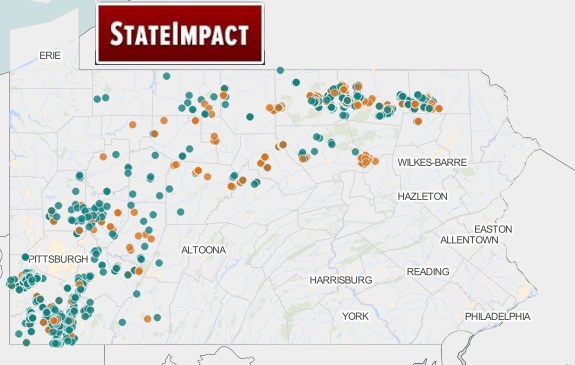
More than 1,600 shale gas wells are plotted in the app, which reflects the state’s most-updated data for 2011. Click on a well, and you’ll learn who owns it, how much gas it’s producing, and whether Department of Environmental Protection inspectors have cited it for violations. Problem-free wells are green on the map. If inspectors have cited a site for violations, it’s plotted as a orange dot — and the citation details are listed on the page.
StateImpact seeks to inform and engage local communities with broadcast and online news focused on how state government decisions affect your lives.
Learn More »