Emily Corwin reported on economics for the StateImpact New Hampshire blog until the project merged with the New Hampshire Public Radio site in July 2013. She is now NHPR’s Seacoast Reporter. You can follow her on Twitter at @emilycorwin, and find her stories on NHPR.org.
This week on StateImpact NH: a three-part series on roads. Transportation funding is a big issue in the legislature this session. A fifteen-cent gas tax has gotten initial support in the House, and advocates of high stakes gambling in New Hampshire say a portion of the revenue from a casino would go directly into the state’s Highway Fund. But getting either proposal through both chambers will be a doozy. So, we’re digging into roads.
Got a bumpy road that makes you grumpy? Share it here.
_______________
Your car and pocketbook Americans pay for bad roads twice. First, on car repairs– Granite Staters spend an average of $323 and as much as $500 annually on car costs due to driving on deteriorated roads, according to TRIP, a transportation trade organization.
Jeff White at Garry’s Service Center in Concord will tell you many of his customers end up with repairs totaling $1,000 in a given year. White says “when you go over a really big pothole, you can damage suspension parts and steering parts.” Frost heaves and potholes also cause a car’s wheels to go out of alignment. Then, White says, “the car will either drift right or left, and what that causes, besides a lot of annoyance, is it quickly wears tires.” Folks driving sports cars will likely have the most road-related damage, White says, including bent and broken rims.
But after those repairs are made, taxpayers pay for bad roads a second time – when they are finally rebuilt with gas tax and vehicle registration dollars. As NHDOT’s Bill Boynton says, a mile of a decently maintained road costs $50,000 to repave; but a mile of deteriorated road costs $1 million to reconstruct. While this may be a boon for auto mechanics and private paving companies with government contracts, poor roads are costly for businesses, governments and drivers.
Business
When it comes to his business, Chuck Crawford, who owns high-tech manufacturer Kimball Physics in Wilton, “roads are critical.” Crawford says since Wilton and nearby Greenville often don’t have the money, his company repairs roads on the company budget. “We’ve done that a number of times,” he adds. Continue Reading →
Readers and listeners have been contributing pictures of the roads they drive on that really drive them crazy. Check out this map, and add your pictures and comments by clicking on the Add button. Zoom out to see all of New Hampshire.
This week on StateImpact NH: a three-part series on roads. Transportation funding is a big issue in the legislature this session. A fifteen-cent gas tax has gotten initial support in the House, and advocates of high stakes gambling in New Hampshire say a portion of the revenue from a casino would go directly into the state’s Highway Fund. But getting either proposal through both chambers will be a doozy. So, we’re digging into roads.
First, we looked at just how bad our roads are. Today, we’ll tell you the 5 reasons our roads are looking beat up. And finally, we’ll look at what that means for your car, your pocketbook, and your safety.
Those potholes you swerve around every day are caused by a confluence of variables. But mostly, it comes down to water, oil and money.
1. It’s all about water.
The kind of weather we’ve seen this winter – a lot of precipitation combined with frequent freezing and thawing and extreme temperatures – will destroy roads, fast. New Hampshire has a lot of frost-susceptible soil, says Jo Daniel of UNH’s Department of Civil Engineering. When rain or melted snow freezes, it forms an “ice lens” in the soil beneath the pavement that pushes up the asphalt causing frost heaves, and ultimately potholes. Not only do the frequent freezing and thawing that we’ve seen recently in New Hampshire degrade roads, but so do the extreme temperatures we saw earlier in the season – when highs near 60 followed lows in the single digits, in less than a week’s span.
2. And geography.
On top of that, New Hampshire is located in one of the worst parts of the country for winter road maintenance. Plowing snow and salting roads takes a $39 million bite out of what would otherwise be road repair budgets, according to the New Hampshire Department of Transportation. Continue Reading →
This week on StateImpact NH: a three-part series on roads. Transportation funding is a big issue in the legislature this session. A fifteen-cent gas tax has gotten initial support in the House, and advocates of high stakes gambling in New Hampshire say a portion of the revenue from a casino would go directly into the state’s Highway Fund. But getting either proposal through both chambers will be a doozy. So, we’re digging into roads.
First, we look at just how bad our roads are. Next, we’ll tell you the 5 reasons our roads are so beat up. And finally what that means for your car, your pocketbook, and your safety.
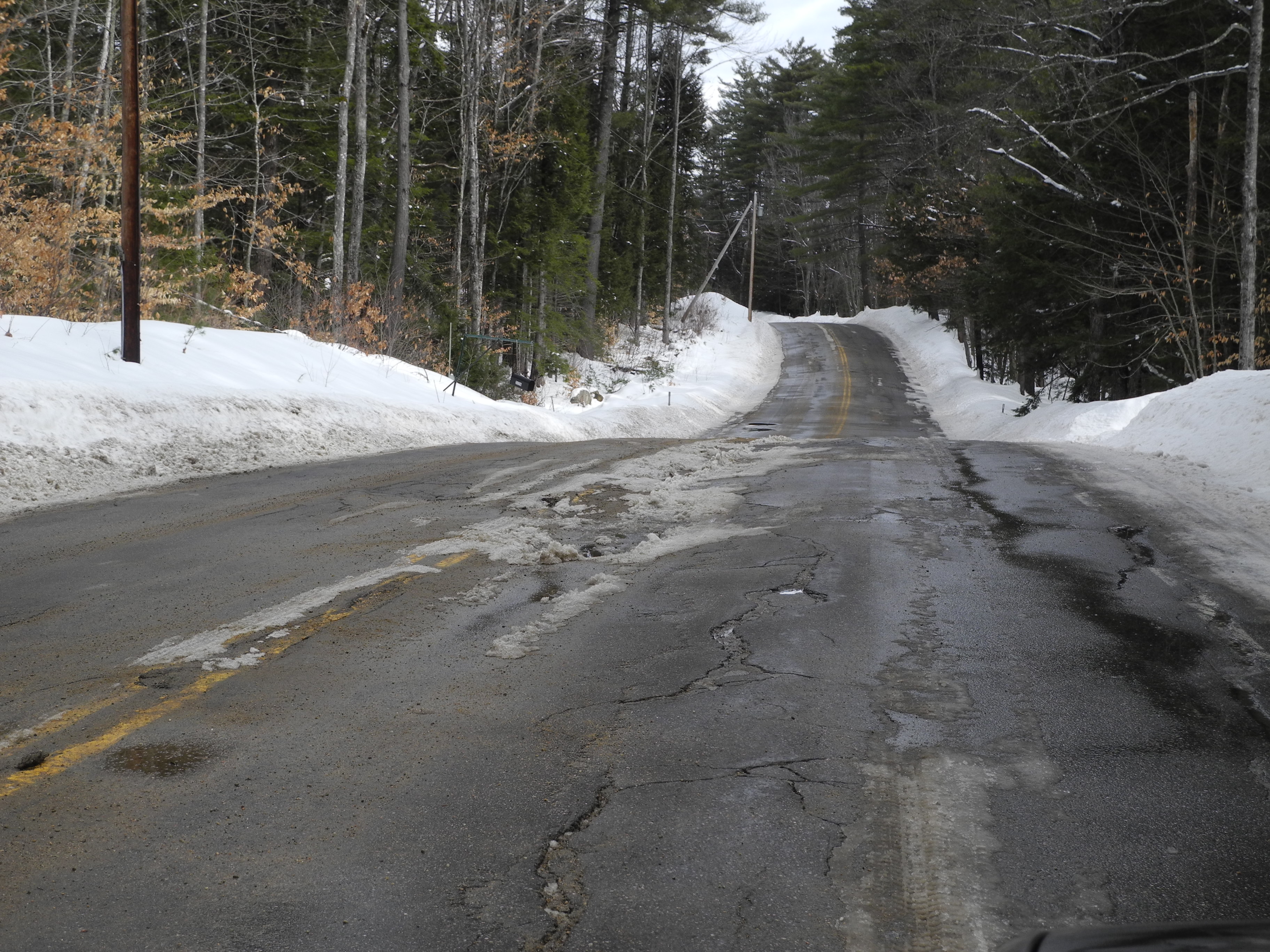
Valerie and Berthold Horn say one road they drive on in Conway could win a “worst road in New Hampshire” contest, hands down.
We have had literally thousands of dollars of car repairs as a result of driving on East Conway Rd. and Green Hill Rd. during the last three years. Unfortunately for us, there is no other way to get to work, or shopping, or anything else for that matter.
NHDOT
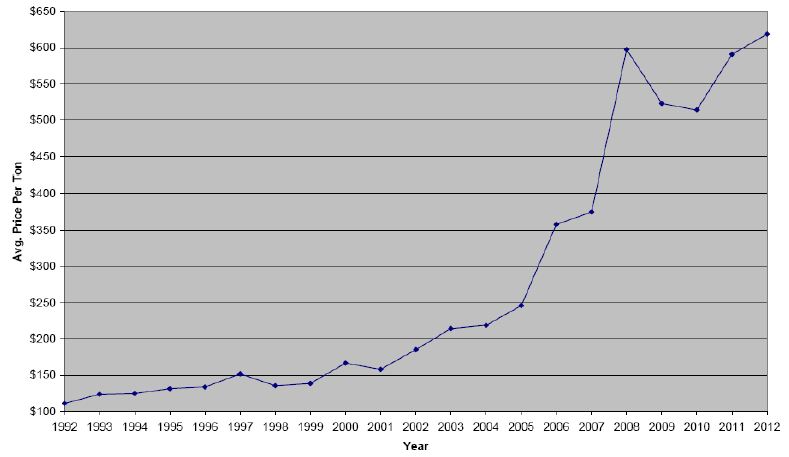
This graph shows the average price for one ton of asphalt, from 1992-2012.
StateImpact NH has heard from a lot of disgruntled Granite Staters, who say the roads they drive on are terrible. And it’s true: the quality of New Hampshire’s roads has been steadily declining. Oil prices are pushing paving costs up, fuel-efficient cars mean fewer gas tax dollars for the state’s Highway Fund, and inflation means those dollars buy less, too.
Today, 37 percent of state-maintained roads and highways are deemed “in poor condition” by the state’s Department of Transportation. Under current funding, that will increase to 43 percent by 2016. And bad roads are getting worse. That’s because it costs twenty times as much to reconstruct a badly maintained road than to resurface one in decent condition. “Fixing worst first,” says Bill Boynton at NHDOT, “you’ll never catch up.”
That’s why people like the Horns say they’re baffled that public workers are repaving the part of the roads that are “actually in reasonable shape.” It costs $50,000 to repave a decently maintained road, and $1 million to reconstruct a failed road.
On top of that, the state prioritizes road repair projects based on traffic patterns. So while interstates may stay in excellent condition, roads less travelled are likely to fall deeper and deeper into disrepair.
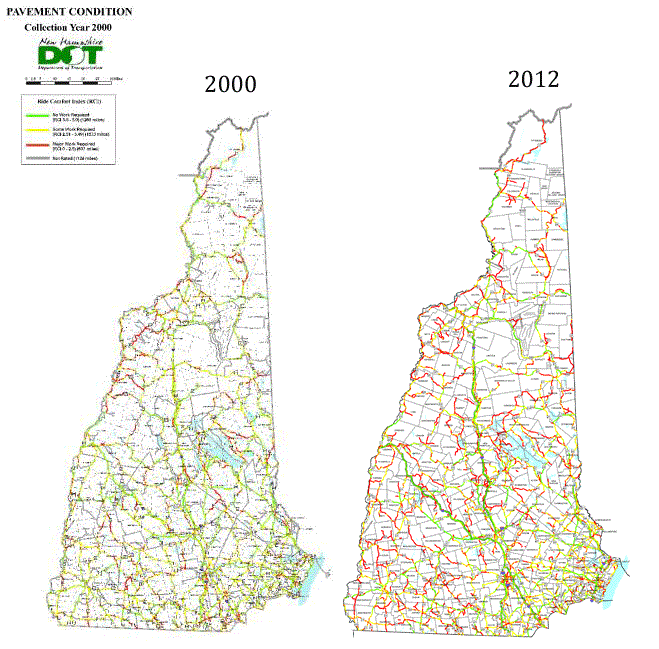
Check out this NHDOT graphic, which compares road conditions from 2000 and 2012.
NHDOT
Miles of roads in poor condition have increased throughout the state. Red lines indicate poor condition, yellow indicate fair, and green indicate good condition roads. All roads are state roads.
Including funding for the I-93 expansion, Boynton says New Hampshire would need $74 million each year just to maintain current road and bridge conditions. To fix all state-owned roads and bridges would cost $1.3 billion dollars.
Valerie and Berthold Horn say East Conway Road in Conway would win a "worst NH road challenge."
Of course, state roads make up only 30 percent of New Hampshire roads. Towns are struggling to maintain their roads too, perhaps even more so than the state. While NHDOT is on track to repave each road every thirteen years or so — three years slower than NHDOT would like — many towns in New Hampshire are on track to repave their roads every 100 years.
“Infrastructure is a big line item,” says Beth Hamilton at the University of New Hampshire’s Technology Transfer Center, which works with municipal public works departments across the state. But, she says, it’s often impossible for towns to choose road repair over education, police and firemen — not to mention more urgent road expenses, like plowing, or rebuilding roads lost to storm damage.
Stay tuned for the next segment of our roads series tomorrow morning, here at StateImpact New Hampshire. And, send us your photos!
“American passenger rail is in the midst of a renaissance,” writes Robert Puentes, the author of the Brookings Institution’s new report on Amtrak ridership in America. At 55 percent, growth in ridership “far outpaces growth in population and economic output” between 1997 and the present. And the Northeast is at the center of a lot of that activity.
Brookings Institution Infographic
Check out the Brookings Institution’s interactive map, blogpost, and full report. The report includes recommendations to state and federal policymakers, and is titled: “American Passenger Rrail In An Era Of Fiscal Restraint.”
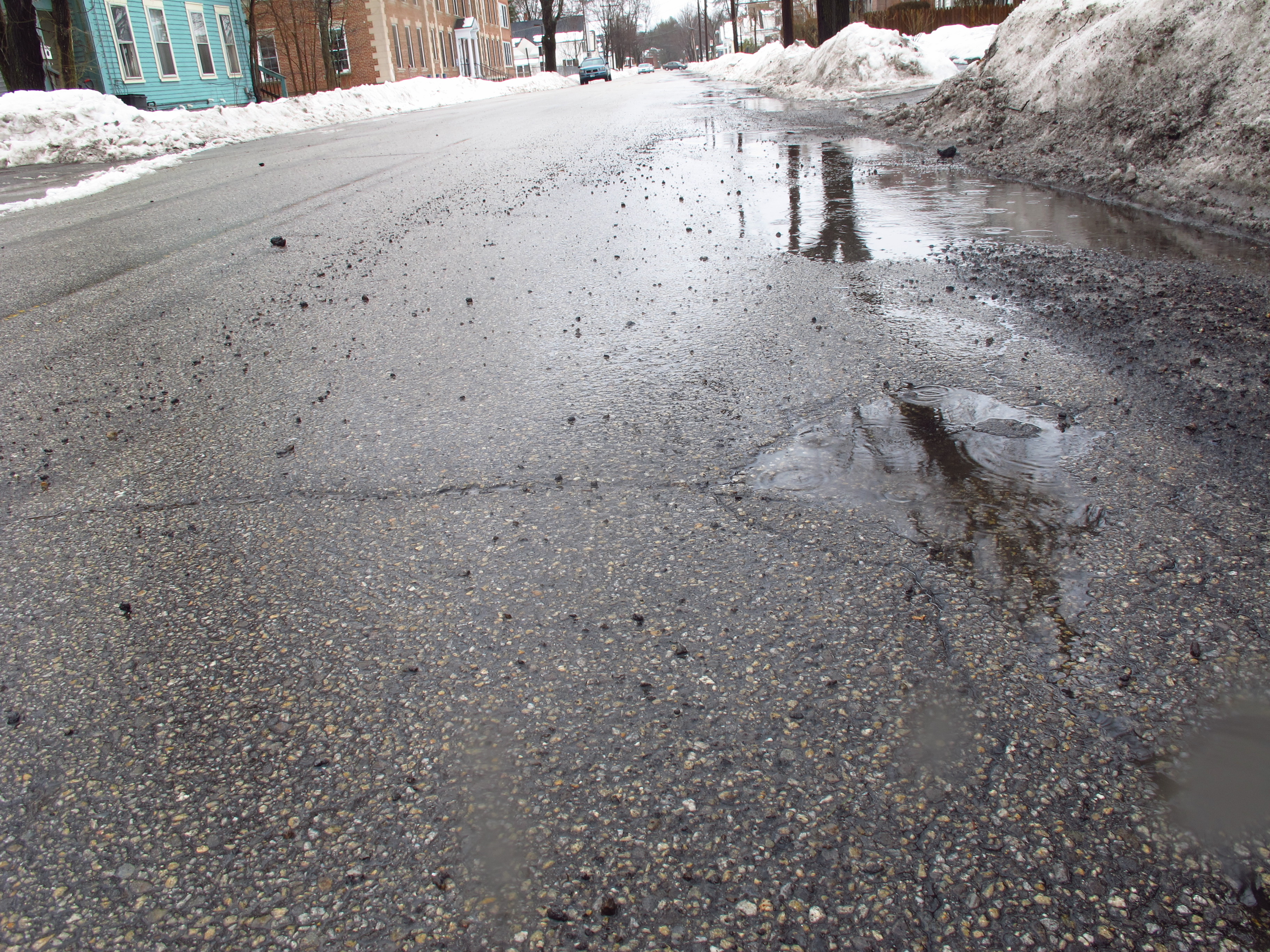
We want you to send us pictures of the worst roads you have to drive on.
Emily Corwin / NHPR
South St. in Concord is on NHDOT's list of roads in poor condition.
New Hampshire roads are in bad shape — and, according to state and city officials, they’re getting worse. While we work on a series about why our roads are deteriorating so fast, we hope you’ll get in touch with pictures or stories about that epic-ly beat up road you’d rather not drive on.
Send pictures, with some location information to roads@nhpr.org. Or, tweet us at @StateImpactNH.
Charity gaming at Rockingham Park in Salem -- the most likely location for a high end Casino.
A new report finds that a casino may create more social costs than tax revenue, mostly because of the 30 percent tax rate included in the Senate bill supported by Governor Hassan.
“The tax rate set at 30% puts us in a situation where the social costs outweigh or come close to outweighing the revenue benefits to the state,” says Steve Norton, the director of the Center for Public Policy Studies, which produced the report.
The so-called “social costs” include unemployment benefits; welfare; arrests; corrections; divorce; health problems and bankruptcy resulting from an increase in problem and pathological gamblers.
Increasing the tax rate proposed in the bill would make a casino more profitable in the long term. However, Norton says, a casino developer would likely only agree to a higher tax rate if the initial license fee were reduced from the $80 million proposed in the Senate bill. Continue Reading →
New Hampshire is attracting more young video game designers. The question is, can the state capture profits by keeping their companies in state? New Hampshire Public Radio’s Ryan Lessard has this story about young designers facing the allure of Boston:
New Hampshire is the birthplace of video games. No, really. Just ask 90-year-old Manchester resident Ralph Baer. He is widely credited as the “forefather” of the video game.
Courtesy of Neal Laurenza
Screen shot of pre-alpha version of Bacon Man. Certain assets like character design have yet to be added.
“All right, take the hand control. My suggestion is that you do what I do. You hold it up against your belly. Put your hand on the English nob. Forget the horizontal one. It will go just straight up and down because as a beginner you can’t handle three controls.”
We’re playing the original pong game on the very first game console. He thought up the idea of making dots move on a TV screen 1966 while working for a defense contractor in Nashua.
Baer’s biggest legacy though, is helping create a video game industry that today has out-grossed Hollywood with a global revenue of $78.5 billion last year. New Hampshire’s economy, however, has never managed to reap the benefits from his innovation. Continue Reading →
Manchester's Dyn, Inc has a farm to table menu for their employees
Lawmakers in New Hampshire are considering a program that would convene industry, nonprofit and UNH representatives involved in the state’s local food and agriculture industry. The group would be charged with researching and reporting back to the Department of Agriculture. The bill’s sponsors are using Vermont as a model.
In fact, New Hampshire’s SB141 is based almost word-for-word on Vermont’s farm to plate bill, which passed that state’s legislature four years ago. The major difference is funding, says Senator Martha Fuller Clark, the prime sponsor of the NH bill. While Vermont has allocated $100,000 annually first from federal stimulus funds and then from their general fund – and more recently appropriated another $1.17 million in grant funding for businesses and technical assistance programs which will be distributed using the Farm to Plate guidelines — the New Hampshire bill will not have an appropriation at all. Continue Reading →
Although Governor Maggie Hassan has thrown her weight behind a gambling bill produced in the Senate, the House Ways and Means committee heard testimony today on two bills sponsored by House members.
Lincoln Representative Edmond Gionet’s bill allows for two casinos – one near the Massachusetts border, like the Senate bill, andanother casino, in the White Mountains. Gionet says his proposal would bring just short of $300 million into the state. And, he says “This bill does not have any politics, it does not have any favoritism.” That’s because it doesn’t specify which towns or developers would get the casino.
The committee also took up a plan sponsored by Representative Steve Vaillancourt. That bill provides for six casinos with a total of 5,000 slot machines. Each would be staffed, managed, and operated by the state. Vaillancourt’s bill estimates around $520 million in revenue, and would allow only for video slot machines, not high-stakes table gaming.
About StateImpact
StateImpact seeks to inform and engage local communities with broadcast and online news focused on how state government decisions affect your lives. Learn More »