Miami-Dade students improved their scores on two of four national reading and math exams, even as scores dropped nationally.
The results are from the National Assessment of Educational Progress, or NAEP — also known as the “nation’s report card.” The test is given every two years in math and reading to 4th and 8th grade students.
The U.S. average scores dropped on each of the four exams — with the biggest declines in 8th grade reading and math.
Education leaders said the latest national scores were surprising and disappointing, but said that scores have improved over the long term.
“The news isn’t great,” U.S. Education Secretary Arne Duncan told reporters.
Duncan said the cause for the decline in national scores isn’t clear, but said the switch to Common Core math and language arts standards in more than 40 states and other new education policies probably caused a downward dip as schools adjusted.
“This is not an infrequent occurrence,” Duncan said.
But those families also want their kids to speak – and read and write – more Spanish in school.
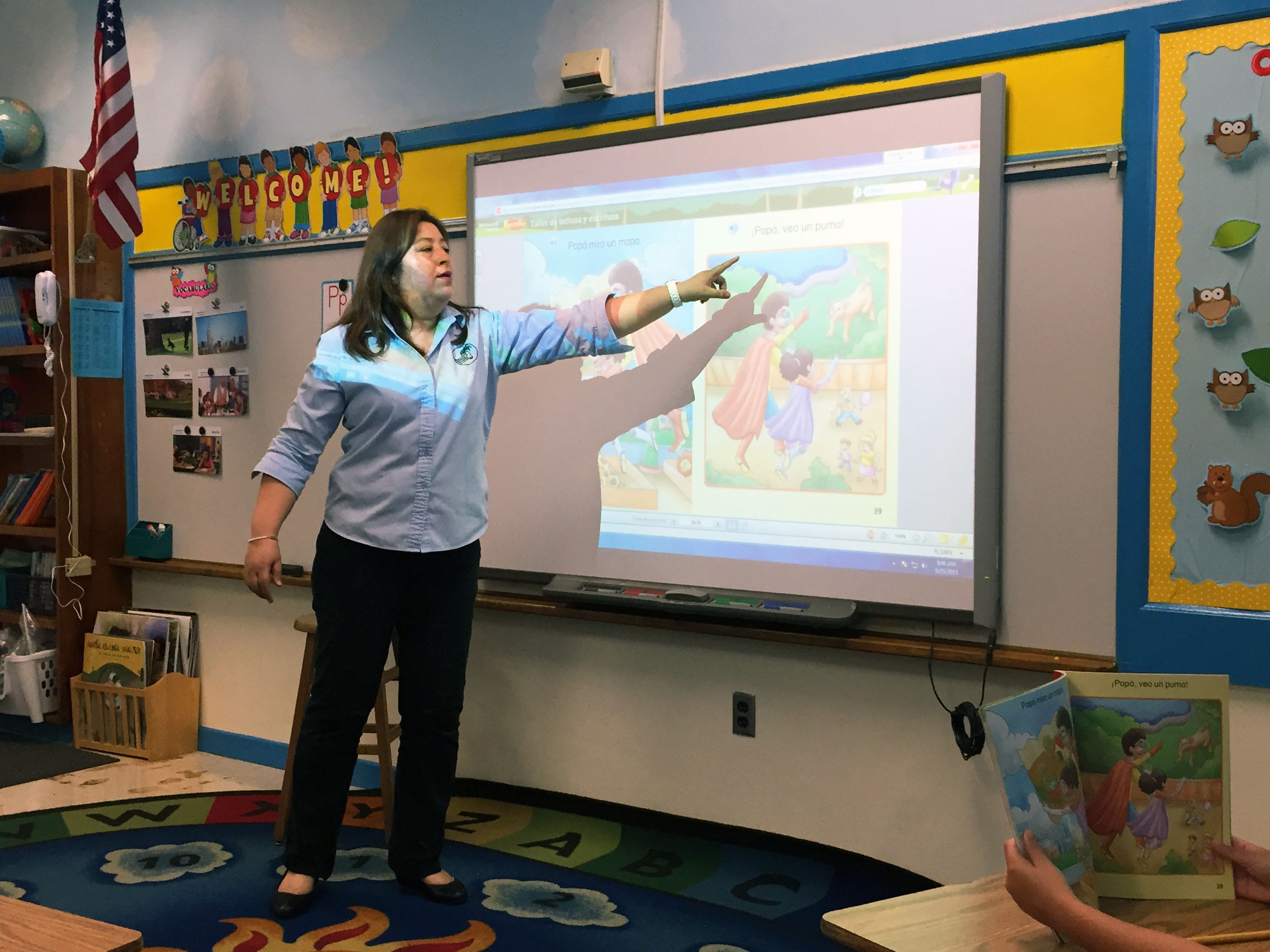
So teacher Alexandra Martin is leading her 1st grade class through “Vamos Papa,” with each child reading a passage from the Spanish language story. Martin helps students through proper pronunciation and words they stumble on.
This is the Miami-Dade public schools’ extended foreign language program, or EFL
Students have 5 hours a week of classes taught in Spanish with additional lessons in English. That’s not just reading and writing, but also math and science.
Spanish is part of everyday life in Miami that’s different from the rest of the country. But Miami-Dade is struggling to find enough teachers qualified in both English and Spanish.
“We had more applicants than we could service so we had to hold a raffle,” said Marta Garcia, principal of Royal Palm Elementary School, near Florida International University. Three students applied for each slot in Royal Palm’s EFL program.
“Parents have realized that it really makes a difference in their child’s education,” Garcia said. “To truly be biliterate and bilingual, it is a big advantage.”
Experts say it should be simple to calculate graduation rates. But it's not.
It sounded like a story guaranteed to irritate taxpayers: a national study out of Rutgers university says more and more public high school students are taking longer than four years to graduate.
Instead, they’re in school for five or six — or more — years!
But Florida school officials say that’s not a problem here. And experts say, they both may be right — the difference may lie in some good news from the last several years.
Graduation rates are an important number because it lets us know how our high school students are doing, in terms of being ready to go to college or go into the workforce.
The Rutgers researchers say the U.S. Census data that they used is a more accurate way to measure graduation rate as it follows individuals through their lives.
They found a decline in on-time graduation through generations of high schoolers born in the 1940s to the 1980s, especially in boys and minority students.There was a definite growing trend for students to graduate well after they turned 18.
But education officials in Florida said, that’s not what’s happening here.
Teacher think lawmakers might have ulterior motives when they created a $44 million bonus program.
“Who are these bonuses for?”
It’s a question we heard from teachers over and over again while reporting on the new Best and Brightest Scholarships. They’re not actually scholarships — they’re bonuses worth up to $10,000 for teachers who scored in the top 20 percent of students when they took the SAT or ACT and earned the state’s top rating, “highly effective.”
Miami Republican Rep. Erik Fresen proposed the $44 million program during the legislative session. He’s said he was inspired by Amanda Ripley’s book “The Smartest Kids In the World.” In the book, Ripley found top students wanted to become teachers in Finland, South Korea and other top-performing nations. That isn’t always the case in the U.S.
Fresen’s bill went nowhere, but he managed to get the money added to the state budget despite objections from the Senate.
For many teachers, qualifying for the bonus meant tracking down decades-old test scores from the two testing companies or from the college they attended. Many teachers said they couldn’t get the records before the October 1st deadline.
It’s why many veteran teachers don’t think they bonuses were meant for them. They think they were intended for young teachers. More recent graduates can get their test scores online and first-year teachers are exempt from the “highly effective” requirement.
Miami teacher Brigette Kinney qualifies for a new state bonus program, but disagrees with the concept.
In Brigette Kinney’s design class at Ada Merritt K-8 center in Miami, one of the key concepts is editing and revising ideas after getting feedback.
Her 8th graders created role-playing games based on books they read. And then adjust the games, after watching their classmates play.
Kinney hopes Florida lawmakers will be as open to change as her students.
“I feel that legislators are out of touch with what it means to be a good teacher,” she said.
Kinney was talking about the new program called the “Best and Brightest Scholarships.” It’s not not actually a scholarship. It’s bonuses for teachers based on how they did on the SATs and ACTs. And they could get as much as ten thousand dollars.
To get the money, teachers need to have scored in the top twenty percent when they took the college placement exams. They also have to earn the state’s top teacher rating – “highly effective.”
Lawmakers in Tallahassee earmarked $44 million in the state budget for the bonuses.
But to get them, many teachers have to track down scores they may not have seen since high school.
The results show what percentage of students in each district scored within each quartile of all Florida students taking the exams. Parents can expect more detailed scores for their students next month.
The state is now setting cut scores for the the exams, which will determine what percentage of students are meeting state goals. Eventually, the state plans to issue A-to-F grades for every public school that will include Florida Standards Assessments results.
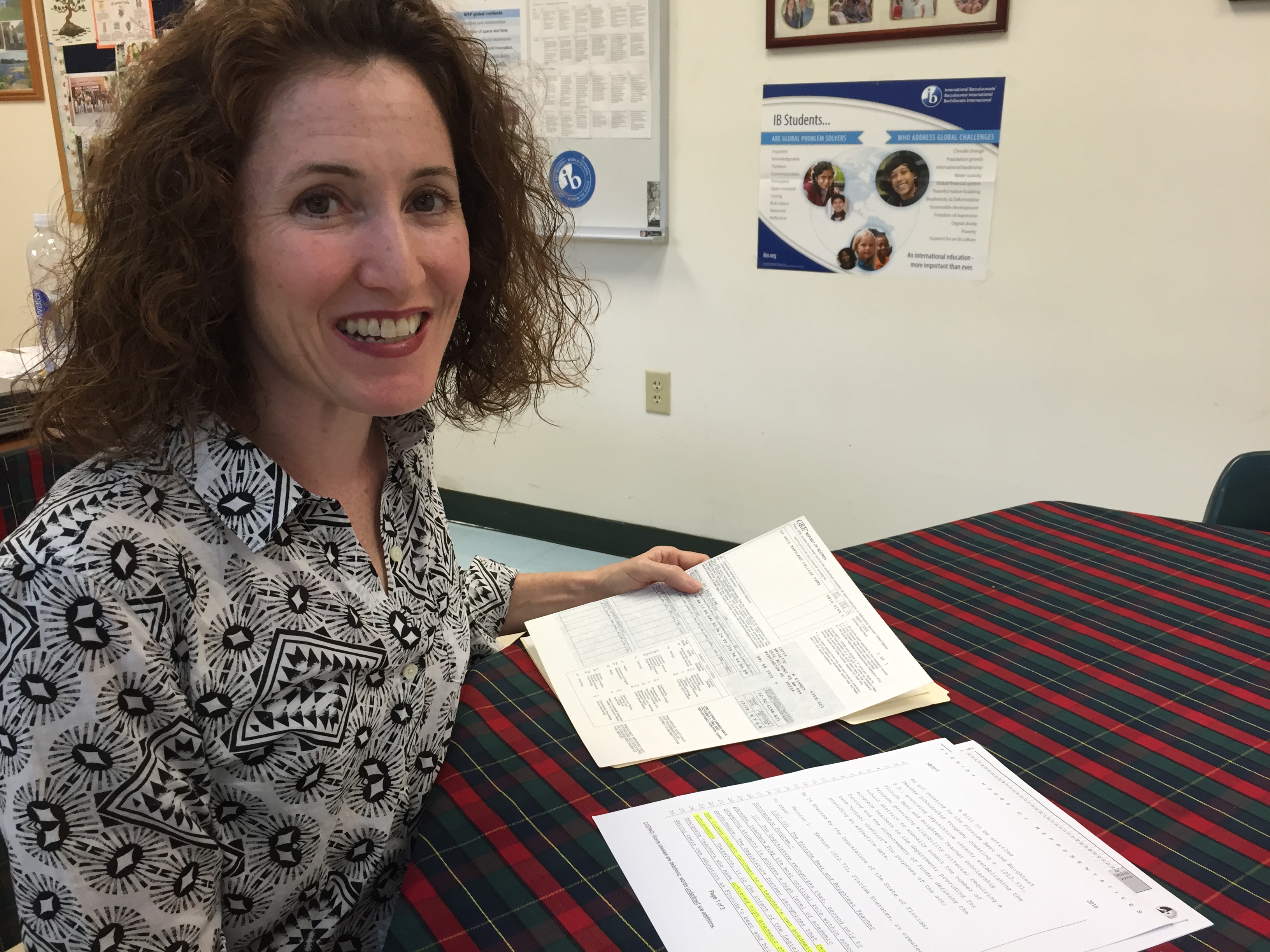
Miami teacher Brigette Kinney holds copies of her GRE scores and the state law creating the new teacher bonus program. She qualifies for the bonus -- up to $10,000, depending on how many teachers qualify -- but may not be able to compete the paperwork in time.
Miami teacher Brigette Kinney said she doesn’t always hear about school news when classes are out for the summer.
But Kinney said she didn’t learn about the bonuses until she returned to school in August — and that may have been too late.
The deadline to apply for the scholarships is Thursday. Kinney meets the requirements, but she’s not sure if her scores will arrive in time.
“I was told it would take two to four weeks to get my score, which I knew was going to be very tight” said Kinney, who teaches English and design in the International Baccalaureate program at Ada Merritt K-8 center.
Some top comedians say they're not performing on college campuses because students are too easily offended. A group is now tracking speech policies on campus.
Know the joke about how many college students it takes to screw in a light bulb?
Probably not, since it’s not a real joke. Nor is the decision some comedians are making to avoid college campuses where they say students today are too easily offended.
Back in June, comedian Jerry Seinfeld told ESPN radio that he was joining Chris Rock, Larry the Cable Guy and others who won’t play college campuses because they’ve become too politically correct.
“I hear that all the time,” Seinfeld told ESPN Radio. “I don’t play colleges, but I hear a lot of people tell me don’t go near colleges — they’re so PC.”
The band GOODING performs at Miami Beach High School. The band visits schools around the country to play their music and teach financial lessons.
You might be forgiven for mistaking Miami Beach High School’s auditorium for the Fillmore Thursday.
Students waved lit cellphones above their heads.
They sang along with “whoa-oh-oh” choruses.
But when the concert ended, they got a lesson in what some have dubbed nature’s most powerful force.
“It’s called compounding interest,” says Gooding, the guitarist who uses only the one name professionally and is lead singer of a band by the same name (though in all caps). “Raise your hand if you know what compounding interest is? I won’t make you say it. Awesome.”
If you watch shows like CSI or have seen a car commercial, you’ve probably heard GOODING’s music.
StateImpact seeks to inform and engage local communities with broadcast and online news focused on how state government decisions affect your lives. Learn More »